Lost Angeles: City of Homelessness
Introduction
Homelessness in Los Angeles has remained a persistent and complex issue for decades, shaped by rising housing costs, economic inequality, and gaps in mental health and addiction support. By 2021, the crisis had reached a point where tens of thousands of people were living without stable housing across the city and surrounding county, making it one of the largest unhoused populations in the United States.
This documentary explores the underlying causes behind that reality, combining insight from experts with the experiences of those living through it firsthand. Through these perspectives, the film looks at how the situation developed over time and what challenges stand in the way of meaningful, long-term solutions.
Additional Resources:
Share This Resource!
Share This Resource!
Quotes
"The homeless count is an imperfect science, and it gives us kind of a baseline to work off of. I believe there probably are more individuals that are on our streets that are invisible because they don't want to be seen."1
"It's mushroomed into an epidemic and it has reached crisis levels because now the homeless encampments are encroaching and destroying the business community, the tourism industry, impacting the quality of life of our residential areas, contributing to the rise in violent crime and just overall misery, while the homeless are dying in record numbers."2
"Homelessness in Los Angeles dates back to the late 19th century when migrant workers arrived in droves on the southern pacific railroad … Skid Row becomes the Skid Row that we know of it in the 1940s and 1950s when that population begins to stay … so the 1970s you see this explosion of all of these services in these communities and communities responded by saying we don't want these services in our communities, we want them somewhere else, and that somewhere else became Skid Row."3
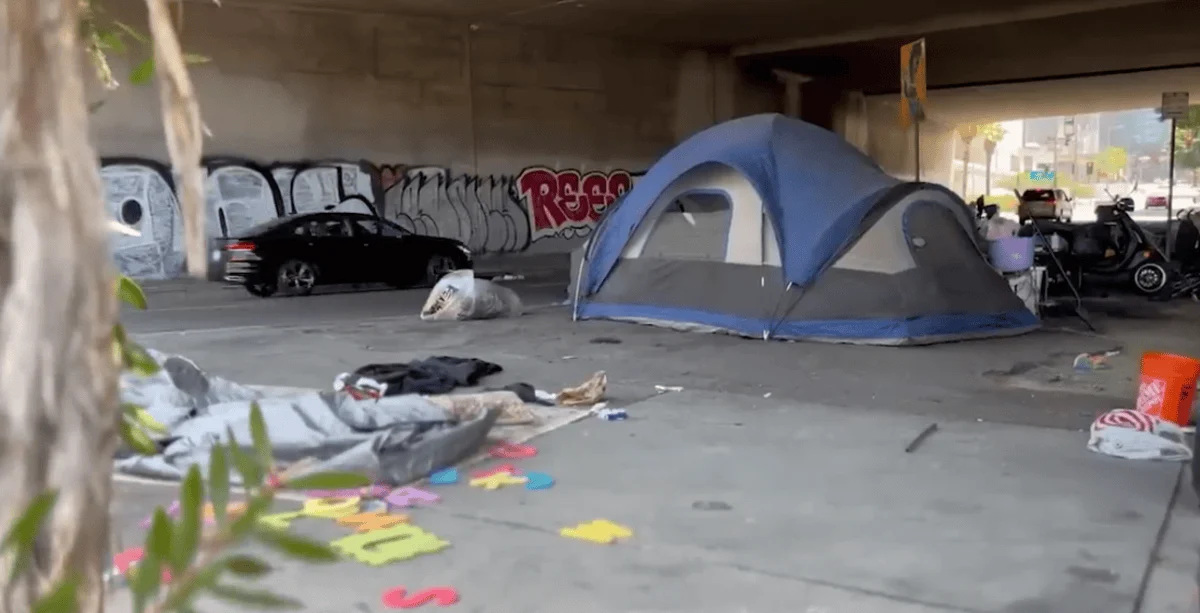
"These are all real people that had lives, that have had jobs, that have had marriages that have had divorces, they've had hard times. They're not there because that was their first choice, this is their last choice, but they become used to it and it's a life that they can deal with and maybe it's too painful to confront their families or their past problems."
"59% of newly homeless in L.A. County cite economic hardship as their main reason for ending up on the street. 32.4% of L.A. County's homeless population is female. Of those, 49% report a history of domestic violence."4
"1 in 4 of California's former foster youth report having experienced homelessness in the two years after aging out of the system."5

"I ran away from home when I was 14 and I was homeless for the next 23 years. After that, I spent most of the 90s in and out of jails."
"Our mission [Hope of the Valley Rescue Mission] is to both prevent and end people's homelessness. This is a place where people can come, they can get off the streets, they can get stable and then we can assist them in ending their homelessness and moving into permanent supportive housing. All of our shelters operate very similarly. We have three meals a day delivered on site. On top of that we have hygiene facilities, laundry facilities, case management and housing navigation, which is the critical piece because it's so hard to get an apartment in Los Angeles."
"Project Room Key is a program that was established out of the coronavirus pandemic. It was the governor's way of helping the unhoused get shelter during the most uncertain time; provided shelter to the unhoused. It took unused hotel rooms or hotel rooms that now were going to be converted into this program to give the unhoused a place to stay."
"There's nothing wrong with HHH as an initiative. What complicated it and what was driven up those costs is how it was implemented. The ones that were supposed to cost $375,000 a unit, they're now averaging $600,000 a unit, some $700,000."6

"I think it's important to realize that homelessness is a traumatic event, that even if you weren't a drug addict before, becoming homeless can change you and it changes you physiologically. The psychosis on the street is due to primarily three things: bipolar disorder, schizophrenias of various type, and methamphetamine, and methamphetamine bleeds over to the other two as well."7
"1963 – President John F. Kennedy signs the Community Mental Health Act into law; 1967 – California Governor Ronald Reagan signs the Lanterman-Petris-Short Act into law."8
"The worst thing we can do is to criminalize poverty, to criminalize homelessness, to criminalize mental illness, and we also know that it's not a solution to just say get off the sidewalk. We have to find a right balance so that we can help as many people as we possibly can."
"What you saw at the VA shows that if there's a political will, things can get done. You can cut through the red tape if you've got the right people saying this needs to stop. It's the same thing that we saw happen in Venice along the Venice boardwalk when people in power, in leadership, want to get something done, they can."
1 The annual Point-in-Time count is widely viewed as a "minimum baseline" rather than an exact total because it inherently misses the "hidden homeless." Many individuals intentionally remain invisible—sleeping in cars, couch surfing, or hiding in remote areas—to avoid stigma, criminalization, or safety risks. While this snapshot is a vital tool for tracking long-term trends and securing federal funding, it consistently underrepresents the true scale of the crisis, which includes a vast number of people living in precarious, out-of-sight situations.
2 Research indicates a complex relationship between homeless encampments and crime, with evidence showing that while they are associated with increased reports of property crime, they are more significantly linked to higher rates of violent victimization within the camps rather than a surge in violent crime perpetrated against the general public. They are significantly more likely to be victims of violent crime (assault, robbery, sexual assault) than to be perpetrators, with studies showing unhoused individuals face violence at 12–19 times the rate of the general population.
3 Skid Row in Los Angeles developed over decades as a concentration point for homeless services, particularly from the mid-20th century onward. As shelters and support services became increasingly centralized in the area, many individuals experiencing homelessness were drawn or directed there, contributing to long-term geographic clustering of unhoused populations and service infrastructure.
4 Data from the 2020 Los Angeles Homeless Services Authority (LAHSA) Point-in-Time Count indicates that a majority of individuals newly experiencing homelessness reported economic hardship as a primary contributing factor. The report also highlights that a significant portion of unhoused women report histories of domestic violence, underscoring the role of both economic and interpersonal factors in pathways into homelessness.
5 Research on former foster youth in California shows a significantly elevated risk of housing instability after aging out of the system, with studies reporting that a substantial proportion experience homelessness or housing insecurity within a few years of leaving foster care. This highlights systemic gaps in transitional support for youth exiting care.
6 A 2022 audit by the Los Angeles City Controller found that the average cost to construct housing units under Proposition HHH had reached approximately $600,000 per unit, with some projects exceeding $837,000 per unit. This exceeded initial estimates (approx. $350k-$400k) and prompted significant debate over the efficiency of the $1.2 billion bond measure approved by voters in 2016.
7 Homelessness, substance use (particularly methamphetamine), and severe mental illness (psychosis, schizophrenia, bipolar disorder) exist in a complex, bidirectional cycle where each factor can cause or worsen the others. A 2024 meta-analysis found that 67% of people experiencing homelessness currently have a mental health disorder, with lifetime prevalence as high as 77%.
8 The Community Mental Health Act of 1963 and California's Lanterman-Petris-Short Act of 1967 were key policies in the deinstitutionalization of psychiatric care in the United States, shifting responsibility for mental health treatment from state hospitals to community-based systems. Scholars note that while these reforms expanded civil rights protections, they also contributed to long-term challenges in adequately supporting individuals with severe mental illness.
Continue Learning
Explore the topics covered in this resource with the links below. Whether you're looking for a quick overview, an in-depth article, or another video, these resources can help deepen your understanding. If there's a topic you'd like to see covered or you're looking for something specific, feel free to contact me.
Explore the topics covered in this resource with the links below. If you're looking for something specific or have a suggestion, feel free to contact me.












Share Your Review
Your perspective matters. By sharing your honest thoughts, you can help others understand what this resource is really like beyond a simple summary. Whether it resonated with you, challenged your thinking, or wasn't what you expected, your feedback helps build a more useful and transparent collection of addiction and mental health resources.
Your perspective matters and helps improve this collection of addiction and mental health resources.
There are no reviews yet. Be the first one to write one.