One Pill: Fighting Fentanyl
Introduction
One Pill: Fighting Fentanyl examines the growing fentanyl crisis across Texas, where overdose deaths continue to rise and victims are becoming increasingly younger. Many people who overdose do not even realize they are consuming fentanyl, making the synthetic opioid especially dangerous and unpredictable. Through the stories of grieving families, survivors, advocates, and law enforcement, the documentary explores the human toll of addiction and overdose while highlighting efforts to raise awareness and prevent further loss.
The investigation also looks at the trafficking networks fueling the fentanyl crisis, the spread of counterfeit pills, and the challenges law enforcement faces in trying to stop the flow of drugs into the United States. Particular attention is given to young people, who can encounter pills and other drugs advertised through social media and online platforms without knowing they may contain fentanyl. Alongside these dangers are stories of parents and organizations turning grief into advocacy, hoping to protect other families from experiencing the same loss.
Fighting Fentanyl: Texas
Nearly one-third of all fentanyl seized at U.S. border crossings enters through Texas, according to a comprehensive report from the Global Initiative Against Transnational Organized Crime (GI-TOC). Intelligence data outlines how illicit synthetic drugs move across the Texas border, who controls the supply chains, and how the trafficking patterns operate.
Additional Resources:
Share This Resource!
Share This Resource!
Quotes
"The crisis has spiraled out of control. Over 5 years in Harris County, fentanyl-related deaths shot up 467%, and for victims 21 and under it's more distressing – a 933% spike."
"The synthetic opioid binds to receptors in the brain to block out pain. It produces an incredible high and is highly addictive – key to a drug trafficker's bottom line. If they get you hooked and you live, you'll be back. If you don't live, then they'll find another client."1

"It only takes two milligrams to kill you. Think of just a few grains of salt."
"When we send our pills to the lab, 6 out of 10 pills are coming back as a lethal dosage. You're playing with your life and there's a 60% chance that you'll end up losing."
"At border crossings like this one, it's a numbers game, a game of odds for fentanyl smugglers who are keenly aware that with so much traffic, U.S. Customs and Border Protection simply cannot inspect it all."2
"Mexican cartels are buying raw ingredients from China and shipping them here to Mexico where they're creating fentanyl in clandestine labs that have no quality control, no pharmaceutical standards – basically making it in bathtubs and garages and back alley drug labs. Then they hire runners to bring it up north playing the odds they won't undergo a full-blown inspection."3
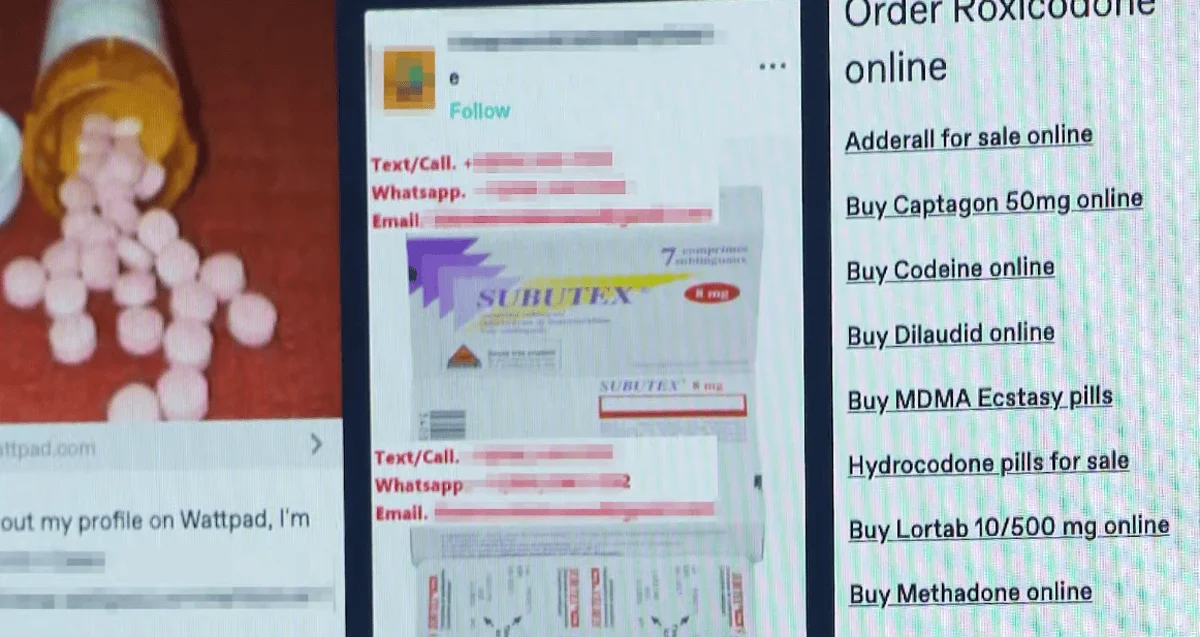
"Computer servers on site and in the cloud work around the clock to flag thousands of drug-related keywords. We collect that data and use our machine learning to classify that data for those people who are explicitly selling and then we visualize it so that different clients can use that information to take action."
"Becky started a non-profit, A Change for Cam, in her son's honor and turned her pain into a passion for raising awareness. She's one of many parents refusing to sit on the sidelines as more die."
"Sarah and three other grieving moms found purpose in their pain and began the Texas Memorial Walkway … this is to maybe stop somebody from going through what we had to go through and to let people know that it can happen to anybody. That's the message they take on the road as part of M-COPE, the Montgomery County Overdose Prevention Endeavor." [They also have a Facebook group]
"Everyone has a role to play in fighting the fentanyl crisis. There is no single solution, no one-size-fits-all. But as the death toll continues to climb, one thing is abundantly clear – doing nothing is not an option."
1 Opioid addiction and dependence are chronic brain disorders associated with long-term changes to brain reward, motivation, and self-control systems. Research has shown that opioids can disrupt the brain's natural reward pathways by triggering large dopamine releases, reinforcing compulsive drug use and increasing physical dependence over time.
2 U.S. Customs and Border Protection (CBP) processes more than a million travelers and large volumes of cargo each day, making it impossible to physically inspect every vehicle or shipment. Traffickers exploit the scale of legitimate cross-border traffic to conceal small but highly concentrated quantities of illicit fentanyl.
3 The DEA identified China as the primary source of U.S.-bound illicit fentanyl and fentanyl precursors during the mid-2010s. After China implemented class-wide controls on fentanyl-related substances in 2019, direct shipments to the United States declined significantly, while production increasingly shifted to transnational criminal organizations operating in Mexico using precursor chemicals sourced largely from China.
Continue Learning
Explore the topics covered in this resource with the links below. Whether you're looking for a quick overview, an in-depth article, or another video, these resources can help deepen your understanding. If there's a topic you'd like to see covered or you're looking for something specific, feel free to contact me.
Explore the topics covered in this resource with the links below. If you're looking for something specific or have a suggestion, feel free to contact me.











Share Your Review
Your perspective matters. By sharing your honest thoughts, you can help others understand what this resource is really like beyond a simple summary. Whether it resonated with you, challenged your thinking, or wasn't what you expected, your feedback helps build a more useful and transparent collection of addiction and mental health resources.
Your perspective matters and helps improve this collection of addiction and mental health resources.
There are no reviews yet. Be the first one to write one.