FLOOD: The Overdose Epidemic in Canada
Introduction
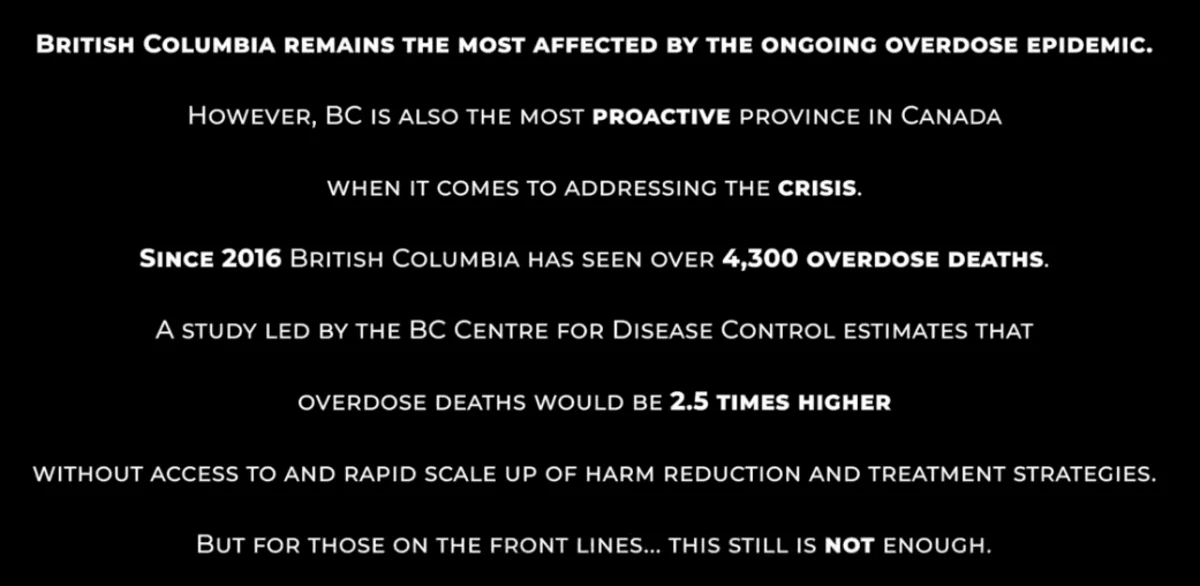
The overdose epidemic in Canada has taken lives at an alarming rate: between 2016 and 2019, more than 12,800 Canadians died from opioid-related overdoses. FLOOD: The Overdose Epidemic in Canada travels across the country to show how deeply this issue is affecting communities—and the people living through it.
Through conversations with advocates, families, and frontline workers, the documentary highlights the role of harm reduction in both preventing and reversing overdoses. It also challenges the stigma surrounding substance use, showing how it shapes the way people are treated and the policies that impact them. Grounded in real stories, Flood offers a clear and compassionate look at a crisis that is still growing.
Additional Information:
Share This Resource!
Share This Resource!
Quotes
"The overdose epidemic does not discriminate. From major cities to small towns. This issue has taken lives, ruined families and has flooded our communities."1
"Supervised consumption sites provide a clean and sterile environment and equipment for people who use drugs. In doing so, these services prevent fatal overdoses and the spread of disease. With overdose deaths on the rise in Canada, supervised consumption services exist in both an unsanctioned and sanctioned capacity. Sanctioned services receive exemption from Section 56 of the Controlled Drugs and Substances Act, a federal law that prohibits activities related to controlled substances. Unsanctioned services are conducted by grassroots movements made up of healthcare workers, activists, and people who use drugs, taking it upon themselves to offer these services in tents in their communities that see frequent overdose deaths."
"I think harm reduction as a concept is kind of agnostic about drug use. It's not that drug use is bad or a good thing. Drug use is a thing that people will continue to do ... I think harm reduction just says we're going to meet you where you're at in your drug use and try to reduce the harms associated with substance use by providing sterile harm reduction supplies so that you're not putting yourself at greater risk each time you use."

"Being surrounded by people who are actively, openly using drugs kept me off of drugs. I'm fucking sick of my friends dying and I wish more people would stand up for us."
"Harm reduction is not only about preventing overdoses but also reversing overdoses when they happen. Naloxone is a drug that temporarily stops overdoses by blocking the effects of opioids on the brain."
"From PSA's we grew up with to what we've been shown in the media, everyone alive today grew up surrounded by deep stigmatization towards people who use drugs. From health inequality to discriminatory policies socially excluding those whose reality we don't understand is common practice in our society. But the consequences for people who use drugs have proven to be catastrophic and addressing the situation is dire."2
"According to the Canadian Association for People Who Use Drugs, safe supply refers to a legal and regulated supply of drugs with mind and/or body altering properties that traditionally have been accessible only through the illicit drug market. Due to the toxicity of the unregulated drug supply, many frontline workers, activists, and people who use drugs have called upon policy makers to implement a safe supply in Canada."
"Project Safe Audience is a harm reduction initiative that targets high-risk behaviours in the rave or after hours music community. We started this about two years ago because we noticed there was a significant lack of harm reduction information that targets the rave community … We go to a lot of these raves and underground events and warehouse parties to give out condoms, lube, earplugs, safer snorting supplies, and we also do onsite drug checking as well as psychedelic crisis intervention for people who may have taken a bit too much."
"According to Health Canada, since Insite opened in 2003, the federal government has provided exemption to 39 sites across the country. However, a discriminatory drug policy and backlash from communities remains an area of concern for the activists and people who use drugs."
1 While opioid-related deaths occur across both urban and rural Canada, surveillance data show that rural and remote regions often experience disproportionately higher rates of fatal overdoses and hospitalizations. In some provinces, mortality rates in sparsely populated areas have been reported at more than three times those in urban centres, highlighting a significant geographic disparity in overdose risk and access to services.
2 Stigma surrounding substance use in Canada is heavily influenced by media, with research showing that a majority of news reports—roughly 69.7% in a 2022 study—portray substance use disorder (SUD) in a negative or stereotypical manner. This stigma functions as a major barrier to care, with over half of Canadians with substance use disorders reporting that societal stigma prevents them from seeking help.
Continue Learning
Explore the topics covered in this resource with the links below. Whether you're looking for a quick overview, an in-depth article, or another video, these resources can help deepen your understanding. If there's a topic you'd like to see covered or you're looking for something specific, feel free to contact me.
Explore the topics covered in this resource with the links below. If you're looking for something specific or have a suggestion, feel free to contact me.










Share Your Review
Your perspective matters. By sharing your honest thoughts, you can help others understand what this resource is really like beyond a simple summary. Whether it resonated with you, challenged your thinking, or wasn't what you expected, your feedback helps build a more useful and transparent collection of addiction and mental health resources.
Your perspective matters and helps improve this collection of addiction and mental health resources.
There are no reviews yet. Be the first one to write one.