PROOF with Guyon Espiner
Introduction
Follow award-winning journalist Guyon Espiner as he explores New Zealand's strong drinking culture, talking with individuals about the personal and community impacts of alcohol. From everyday drinkers to those struggling with addiction, the documentary captures how alcohol affects lives and highlights the often-overlooked harms within communities. Espiner also speaks with a representative from the alcohol industry, who argues for alcohol's potential benefits — but the film critically examines these claims.
The documentary delves deeper into the structural issues that perpetuate alcohol-related harm, such as the concentration of liquor stores in poorer neighborhoods and the lack of support for affected communities. Through these stories, PROOF exposes the predatory nature of the alcohol industry while giving voice to those directly impacted. Espiner's reporting is both investigative and compassionate, providing a clear picture of how alcohol shapes lives across New Zealand.
More from Guyon Espiner:
Share This Resource!
Share This Resource!
Quotes
"We've got an environment that we've created through cheap alcohol readily available, highly marketed. It sends the signals of a pro-drinking culture, and that's something we've got to turn around."
"It's not until you stop drinking that you actually realize that Aotearoa is drowning in booze. If you count all the on-and-off licenses, there are about 11,000 places you can buy booze, or one outlet for every 330 adults. So, yep, the liquor industry has got you covered. And they've decided that people in the poor areas are going to be some of their best customers."

"Raawiri is the co-chair of the Health Coalition's Alcohol Expert Panel. His focus is on research and advocacy aimed at reducing alcohol harm for Māori. But as well as the facts and the theory, he brings life experience."
"One of the first things you realize when you start trying to figure out why the alcohol industry has such a hold on us is [that] they have the power, money and millions of customers for an addictive product."
"They call themselves Communities Against Alcohol Harm, and their mission is to try and stem the rising tide of booze outlets in South Auckland."
"The odds are massively stacked against poor communities in this battle. To try to stop another bottle store going up in the neighbourhood, you have to take your objection to the District Licensing Committee. But of course, the liquor industry can afford to hire high-powered lawyers to fight their corner, and the community — well, mostly, they can't afford to do that, and... they lose."
"The Auckland Regional Public Health Service looked at more than 16,000 alcohol licence applications over four years. Just 180 of those were heard at a District Licensing Committee hearing, and in nearly 90% of those cases, the liquor licence was granted."
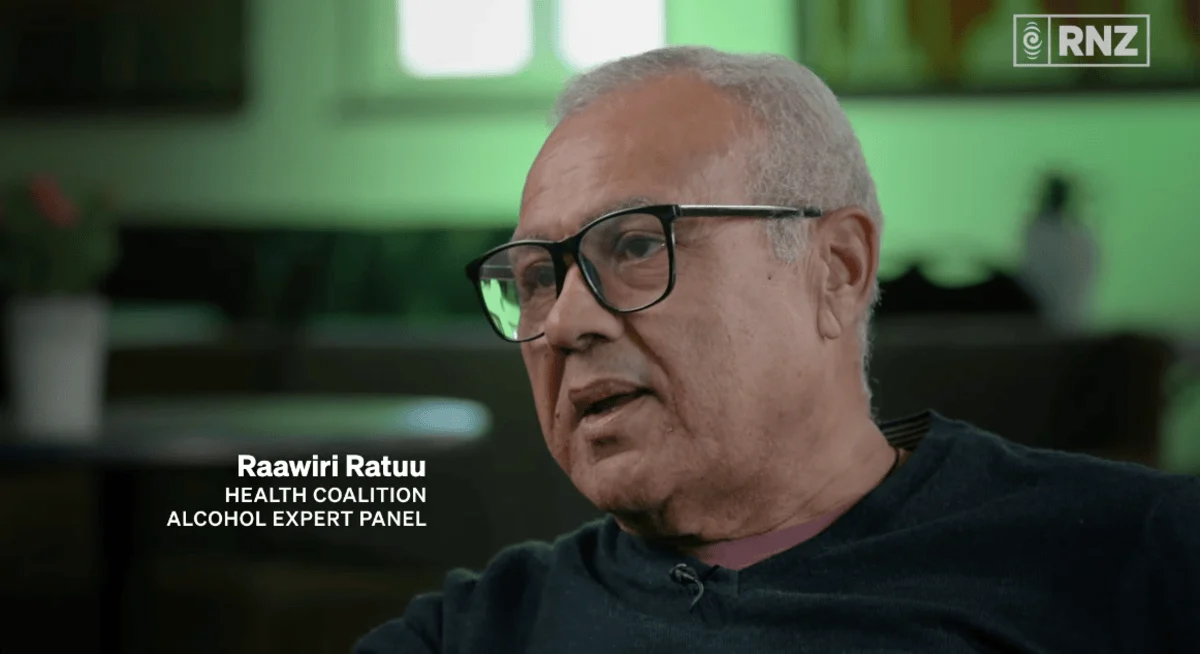
"You don't know how it's harmed my people, or if you do, you're deliberately ignoring it. Deliberately ignoring it because you have a responsibility to make profits for your shareholders."
"Raawiri Ratuu is part of a long tradition. Māori Wardens have a 160-year history in Aotearoa. First Māori Warden that was appointed by Pōtatau Te Wherowhero was from Port Waikato. His job was to patrol the Mangatāwhiri River, to catch the bootleggers coming up there in the boats, and they'd catch 'em with booze, and they'd smash it and tip it all out."
"Even as children, we are heavily exposed to alcohol advertising. An Otago University study put cameras on 168 children aged between 11 and 13. It found that kids are exposed to liquor advertising, on average, nearly five times a day. Raawiri Ratuu points out that in that study, tamariki Māori had five times the exposure to alcohol marketing than European children."2
"So, where do young people get their information about alcohol? In high schools, they get it from SMASHED. It's a drama-based program taken up by about 100 New Zealand schools. It's funded by a charity called The Tomorrow Project … 'a charitable organization that's funded by the industry to put in play programs that will help create a moderate drinking culture in New Zealand'."
"In 2020, 750,000 newly diagnosed cancer cases around the world, or about 4%, were attributed to drinking alcohol, according to a study from The Lancet Medical Journal. In New Zealand, drinking alcohol was responsible for nearly 240 cancer deaths in 2012, according to a University of Otago study."
Continue Learning
Explore the topics covered in this resource with the links below. Whether you're looking for a quick overview, an in-depth article, or another video, these resources can help deepen your understanding. If there's a topic you'd like to see covered or you're looking for something specific, feel free to contact me.
Explore the topics covered in this resource with the links below. If you're looking for something specific or have a suggestion, feel free to contact me.






Share Your Review
Your perspective matters. By sharing your honest thoughts, you can help others understand what this resource is really like beyond a simple summary. Whether it resonated with you, challenged your thinking, or wasn't what you expected, your feedback helps build a more useful and transparent collection of addiction and mental health resources.
Your perspective matters and helps improve this collection of addiction and mental health resources.
There are no reviews yet. Be the first one to write one.